| By News Review - Karl Grossman | |
| April 18, 2002 | |
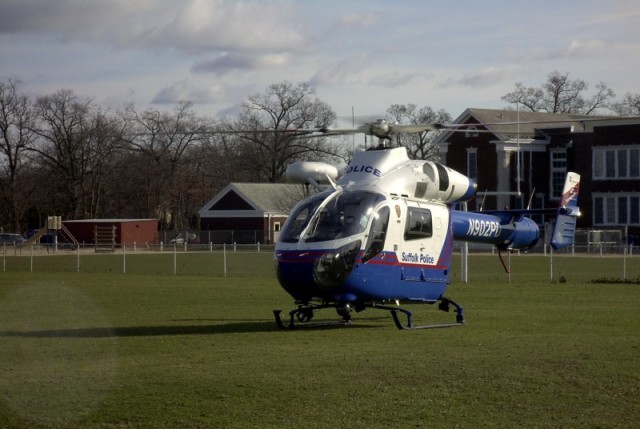
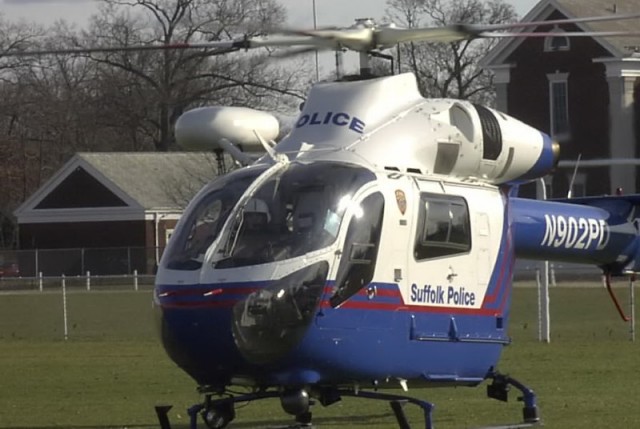
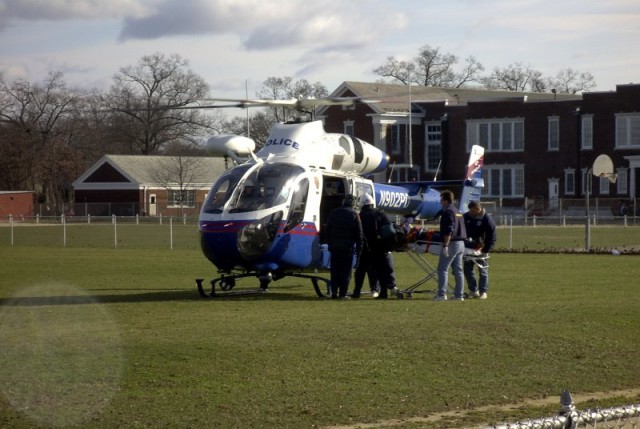
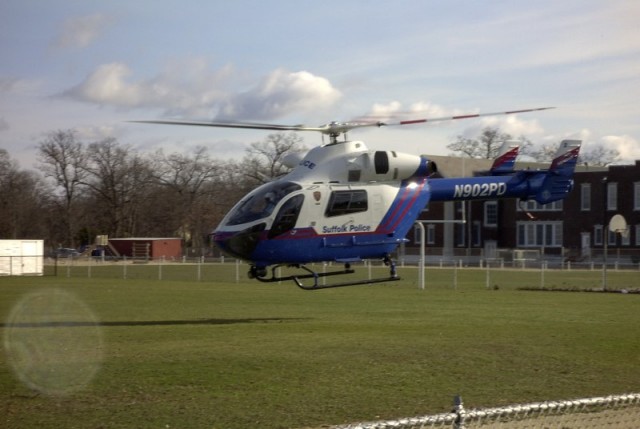
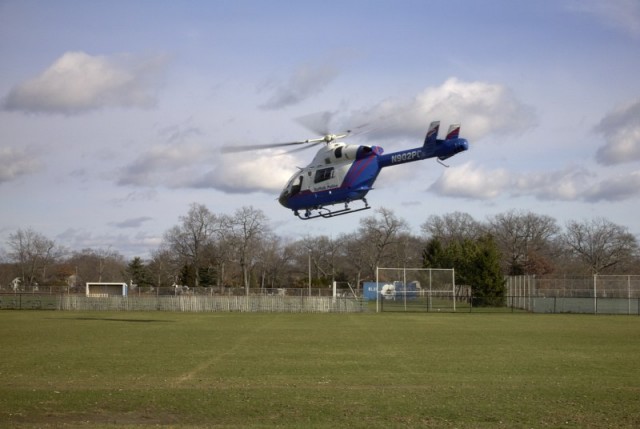
The Suffolk Legislature voted unanimously this week to base a Suffolk Police Department medevac helicopter year-round at Francis Gabreski Airport in Westhampton. The move came in the face of a day-long lobbying effort by more than 200 emergency medical and fire department personnel. The legislature's Budget Committee last week had tabled measures authored by Legislator Fred Towle (R-Shirley) to have a medevac helicopter -- a chopper especially equipped to handle trauma cases -- stationed at Gabreski 12 months a year. For parts of the last two years, one of the three county police medevac helicopters has been at Gabreski and the other two at Islip Town's Long Island MacArthur Airport in Ronkonkoma, the base for the Suffolk County Police choppers. The 20-minute difference in flight time to the East End between Gabreski and MacArthur is credited with the chopper's having saved lives on the East End. But the effort by Mr. Towle, whose district encompasses southeastern Brookhaven Town, to extend the medevac stationing at Gabreski all-year has been blocked by a grouping of western Suffolk lawmakers. In 2001, his legislation to have a medevac helicopter at Gabreski all year expired after being stalled in committee for months. Thus, on Dec. 31, 2001, the chopper returned to MacArthur. At the start of 2002, he re-filed his legislation. But it didn't look like it had much of a chance of passage -- including into much of the session Tuesday in Riverhead. But gazing out from their horseshoe table at signs held by emergency medical and fire department personnel declaring "What Is A Life Worth?" and "We Live On The East End Year Round," all the legislators finally came around. "I'm ecstatic," said Mr. Towle, who gave much credit to the turn-out of emergency medical and fire department personnel that his office organized Mr. Towle said: "The people of eastern Brookhaven and the East End who do this volunteer work were united." Legislator George Guldi (D-Westhampton Beach), whose district includes East Hampton and Southampton towns, said he was especially happy that the legislation specifically calls for all-year medevac basing at Gabreski through 2002 "and every year thereafter." Said Mr. Guldi: "That means it's permanent." Legislator Michael Caracciolo (R-Baiting Hollow), whose district includes Shelter Island, Riverhead and Southold towns, said "the justification, the facts and the overwhelming support of the fire and medical services helped us to achieve this important victory for the residents of and visitors to the East End." Dr. Robert D. Barraco of the Division of Trauma and Surgical Critical Care at University Hospital in Stony Brook explained to the legislators how in the early 1970s the practice of "medical evacuation" by helicopter was developed by Dr. R. Adams Cowley of the University of Maryland's Shock Trauma Center. It was modeled, he said, on U.S. military experience in the Korean and Vietnam wars which showed that quick transport to medical care sharply reduced deaths. It was Dr. Cowley, he said, who first referred to the vital first hour for medical care as the "golden hour." Edward Boyd, a Southold lawyer and emergency medical technician, past chief of the Southold Fire Department and a member of the Shelter Island Red Cross Ambulance, spoke of the East End being "a unique region for many reasons, not least of which are its resources and its geography. While our neighbors to the west are blessed with an abundance of good hospitals and the ability to summon assistance from all directions," he said, "such is not the case on the East End. We are served by a total of three hospitals and, as good as they are, they are not trauma centers. For that level of care we must rely upon University Hospital at Stony Brook Our transportation of patients is severely compromised by the limited access afforded by only two, or in many places just one, east-to-west highways and by the long distances involved." He spoke of the medevac helicopter at Gabreski and said "the arrival of the helicopter signals to each of us in the field that the best possible care for our patient has arrived on the scene and that all that can possibly be done for that patient is being done. Conversely, it is impossible to put into words the disappointment and frustration we feel when provided with 35- and 45- minute estimated times of arrival for a helicopter coming from Islip. That is time being wasted from the account of a patient who cannot afford such waste and still survive. Late in the day, arrangements were made for County Executive Robert Gaffney's office to issue a "certificate of necessity" for a legislative vote on the Towle legislation. At about 5 p.m., Suffolk County Police Commissioner John Gallagher testified that there was a "valid medical necessity to having a helicopter" at Gabreski all-year. He provided financial data assessing the cost at $829,000, including $367,545 for aircraft operation that would be incurred regardless of where the helicopter is based. The "certificate of necessity," signed by Mr. Gaffney's chief deputy, Eric A. Kopp, arrived by fax at 6:28 p.m. When the vote was held, every member of the panel supported the all-year basing -- and applause erupted from the emergency medical and fire department personnel who had held on through a long meeting day. |
|
|
|
|
|
|
|
|
|
|
|
|
|