(editors note: The Riverhead Fire Department's Annual Drill is fast approaching, scheduled for Saturday July 18th, 2009. The following article describes how these firefighting competitions all began.)
Hey, Where's the Fire? A look at fire fighting's competitive side
Annette Hinkle - The Sag Harbor Express - 05/21/2009
We are all aware of the vital role local firefighters play in the life of a community. Whether they are part of a paid force or all volunteer company, the speed with which firefighters respond to emergencies is impressive and young children can't help but want to emulate them when they see the bright engines flashing by and brave men (and sometimes women) riding to the scene of a fire.
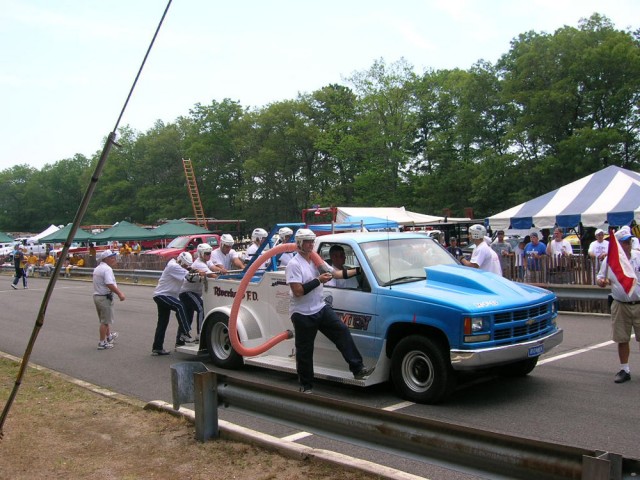
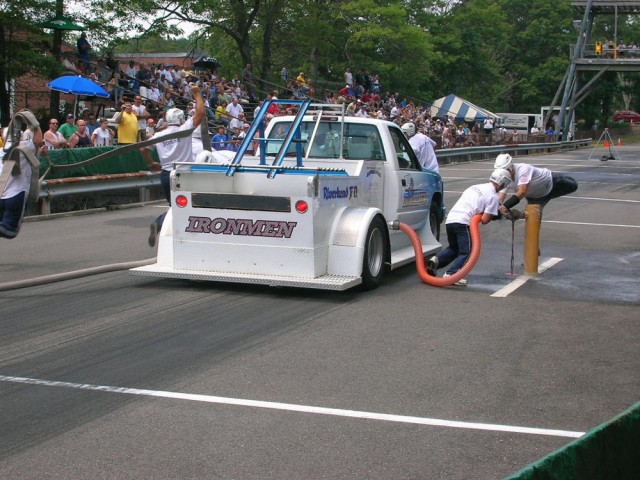
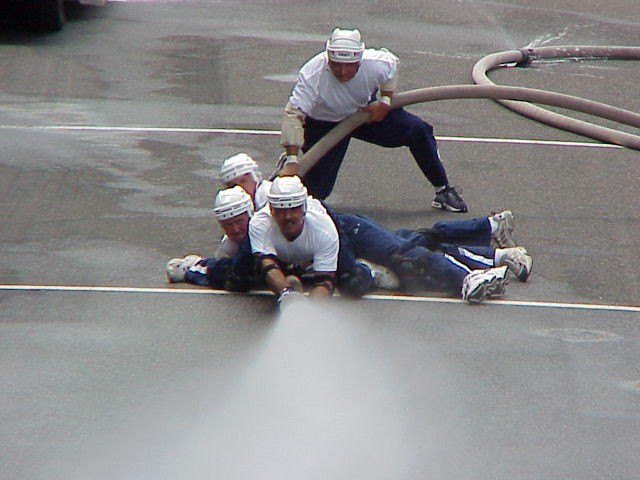
But there is another activity that many firefighters in New York State engage in during their free time that most people probably don't even realize exists. Known as firematic competitions, these are contests held throughout the state that pit fire companies against one another in skills that are a part of a firefighter's job. These companies meet and put themselves through the paces — taking part in bucket brigades, ladder climbing competitions and timed events that involve hooking a hose from a truck to a hydrant, and hitting a target with water in a matter of seconds.
East Hampton's Michael Heller has long had an interest in the culture of firefighters. A professional photographer and himself a member of the East Hampton Volunteer Fire Department, Heller has often merged his two interests and has used his camera to document the life and work of firefighters around the country.
Heller, who writes for Fire News, a newspaper based on Long Island, has been documenting firematic competitions for the paper for years. It occurred to Heller that while the competitions have a big following among the departments that take part in them, very little has actually been documented about it.
http://www.youtube.com/watch?v=r0ZSSwTsmrY (opens in a new tab)
"I got to know the teams and the guys," says Heller. "There's lots of history, but it's in their garages, or in their heads about trucks they built. I realized that it's a sport that's almost 200 years old and no one had ever written about it."
So Heller set out to do exactly that. He criss-crossed the state pouring over accounts of competitions in libraries, visiting with fellow firefighters and looking at old photos or documents they had stashed in their attics. As a result, Heller recently published a book on the sport entitled "Chariots of Firefighters: The History and Practice of Firematic Competition in New York State."
"The more I dug, the easier it became to find," says Heller. "I started getting bits of information that was relevant, but because no one had ever organized it, it was like dropping the pieces of a jigsaw puzzle from 10,000 feet. I began categorizing all the information and once I started putting it in order, it started to fall into place."
In his research, Heller was able to trace the origins of firemen competitions back close to two centuries — long before the advent of the gas engine. Just like rival football teams demonstrate their physical prowess on the field, so too the early competitions were a way to show off a little — especially given the fact it was sheer muscle that moved the water in those days.
"It started out just with pride," explains Heller. "Whether it was New York City or in rural places, back in the day when any little town would get their first "engine" — usually hand pumped — it was a big deal. These were brought over from England, they would paint it beautifully and everyone turned out."
On thing led to another, and Heller adds that when a neighboring town got an engine of their own, the crowds would turn out to see that one as well. Pretty soon, the ante would be upped to the point of companies putting their pumpers to the test against one another in a friendly competition.
"They'd meet at a prescribed time, sometimes there'd be a wager, sometimes not. They'd pump the truck and see who could shoot the water the farthest," says Heller who notes that as long as there have been firemen, there has been competition between them. Today, though competition between firehouses is generally friendly and fire departments cooperate with one another in a civil manner, that wasn't always the case.
In 19th century New York City, Heller found that fighting fires was perhaps sometimes more a matter of ego and pride than saving life and property. In the early days of volunteer forces, fire companies just around the corner from each other would often go to great extremes to beat the other to the scene of a fire.
"Around that time, firemen were like rock stars," says Heller. "When they ran down the street pulling the engine, the crowds would come out and watch. Back then, a fire could devastate the whole city and there was a lot of rivalry."
Often, rival companies would even duke it out on the street while fires burned. The tactics of the companies got down right despicable. In his book, Heller describes how firehouses had roving bands of thugs — boys who would race to fires at the first call and place barrels over the closest hydrants so other responding companies couldn't find them.
"Almost to make matters worse, the insurance companies put an oval plate on some buildings which meant it was insured by that company," says Heller. "When they pulled up and saw the plate, the firemen knew they'd get a bonus for putting that fire out. If they came to a building that wasn't insured, they wouldn't work as hard to put it out."
As an interesting side note, Heller says that the reason Dalmatians came to be known as fire house dogs is because of the role they played in providing security for 19th century companies, not, as many people might think, because of their heroic behavior at fire scenes. Often while firefighters were on site working the hoses, rival companies would literally cut the hoses of the first company and take over the job — and any reward money that might come with it.
"They carried the Dalmatians on the truck to guard the equipment and keep other companies away," says Heller. "They were guard dogs."
Security dogs and hydrant thugs were the least of it. Heller notes that things devolved further, and soon knives, clubs and even Boss Tweed were involved. Graft was a big part of the firefighting business in New York, and there were riots while the city burned.
"Public opinion started going downhill," says Heller. "In 1865, the city turned it into a paid department, and there was no more racing to fires."
These days, firematic competitions have become a way for volunteer fire departments to work out their rivalries and competitive spirit. Long Island competitions began around 1886 and each year, grew more and more formalized. Sag Harbor was one of the first fire companies on Long Island (and in the state) and a charter member of the Suffolk County Volunteer Fireman's Association, which hosted the competition.
"Every year there was a convention and tournament," says Heller. "In 1888, the third annual tournament was held in Sag Harbor."
Accounts in newspapers from the day describe the large crowds who watched the competition and visited big white tents set up on Long Wharf where vats of coffee were served to the spectators.
Heller notes that Sag Harbor hasn't taken part in the firematic competitions since the 1960s or 1970s, though it remains a huge sport for many fire companies on Long Island. He adds that in New York State, the Long Island firefighters are known for taking the competitions particularly serious. Though there are various contests that firefighters can take part in, Heller describes that most competitions consists of a series of events known as the "Big Eight.'
"It's a derivation of how efficiently you can throw a ladder, hook up a hose and spray a target," he says. "It evolved from running with the hose and hooking it up. Back in the 1920s and 1930s, they'd use the service fire truck. After a while, they were beating the hell out of the service truck to compete."
In order to spare the trucks for fighting real fires, companies began building custom trucks to compete. These have evolved to become quite elaborate and fall into two classes. Heller describes class B trucks as modified pickups with pumps. Then there are the class C trucks. These are built to look almost like race cars and can reach speeds of up 80 mph with firefighters hanging off the back. And some teams still compete the old fashioned way — using hand pumps on wheels that they pull themselves.
The state firematic competition draws about 60 or 70 teams and is held each August in one of the four regions that make up New York State. This year, the competition will be on Long Island — in Hempstead — good news for local fans and curiosity seekers alike.
"All the records from the season are off the table that day," says Heller. "It doesn't matter if you won 20 of 30 drills where you are from. It's a one day competition where the top winner is best in the state."
"Just about every state does this in one form or another," adds Heller. "But New York State is the only place in the world that has developed it to this point."
Michael Heller's book is available by visiting his website: http://cof.911pictures.com (opens in a new tab)
http://sagharborexpress.sagharborpublishing.com/shexpress (opens in a new tab)
COME OUT AND JOIN US ON JULY 18th! |


.jpg)
 Add a Comment
